
THE SHORT ANSWER
For most North Texas patios we recommend pavers or travertine over poured concrete, because our expansive clay soil tends to crack concrete and both alternatives flex with the ground and are repairable. Concrete is the cheapest upfront; travertine is the premium, cooler-underfoot choice; pavers strike the balance for durability and easy repair.
The material under your feet shapes everything that follows: how the patio looks, how it feels on a hot afternoon, how it weathers our storms and soil, and what it costs to install and maintain for the next two decades. Three options dominate the decision — concrete, pavers, and travertine — and while all three can make a beautiful patio, they don't perform the same way in North Texas. Here's an honest comparison, including where we'd steer you one direction over another.
A note on pricing: the figures here are market estimates drawn from current 2026 North Texas and Texas cost data, meant for budgeting orientation. They are not PROvision quotes. Every project varies with site conditions, materials, and scope, so the best number always comes from a free on-site estimate.
Cost at a Glance
Before the nuance, the rough order of cost. Poured concrete is the most budget-friendly option upfront. Pavers sit in the middle, with concrete pavers lower and natural-stone pavers higher. Travertine is the premium choice. But — and this matters in our market — upfront price and total cost over time are not the same thing, because the cheapest material to install isn't always the cheapest to live with once the ground starts moving.
Concrete: Affordable, but Mind the Clay
Concrete pours fast, costs the least upfront, and with stamping or coloring it can mimic stone for less. For a clean, functional surface on a tight budget, it has obvious appeal, and on the right site it's a perfectly sound choice.
The catch is our soil. North Texas sits on expansive clay that swells with moisture and shrinks when dry, moving the ground under a slab throughout the year. Concrete handles that movement by cracking, and where it cracks is only partially predictable. If the expansion and control joints are planned properly — typically every eight to twelve feet, with expansion joints at edges and columns, we will account for the most predictable movement. Get the joints wrong, and the crack shows up straight across your new patio or right where a table leg sits. Even with proper joints, concrete is still likely to crack. We'll pour concrete when it's the right call, but we plan the joints like they matter, because they do.
There's one more place we steer homeowners off concrete specifically: root-heavy or sloped areas. In those conditions, concrete will crack unless significant prep and reinforcement are built in, and even then a repair is rarely invisible. That's usually where pavers earn their keep.
Pavers: the Repairable Workhorse
Pavers are our frequent recommendation for North Texas yards, and the reasons are practical rather than aesthetic. They come in concrete, brick, and stone varieties and a huge range of shapes and patterns, so the design flexibility is enormous — you can see the materials we work in on our hardscapes and surfaces page. More importantly, they handle ground movement gracefully. Instead of cracking, the field of pavers flexes, and when a single unit does chip or stain, you replace that one paver rather than resurfacing an entire slab.
That repairability is exactly why we often recommend a paver system over concrete in tricky spots, like root-heavy or sloped areas where a poured slab is fighting a losing battle. The trade-offs are honest: pavers cost more upfront than concrete and the installation is more labor-intensive, since each unit is set by hand over a carefully prepared base. They also ask for occasional joint re-sanding. For most homeowners, the durability and easy repairs make that a worthwhile trade.
Where Paver Installs Succeed or Fail
A paver patio is only as good as what's under and around it. The compacted base and the perimeter support — concrete ribbons or curbing, proper edge restraint, geo-grid at the edges — are what keep the field from settling, tipping, or eroding. This is the most commonly cut corner in hardscaping, and the most common reason a flawless-looking patio becomes an annual maintenance headache. Even a slight grade, a six-to-eight-inch drop over ten feet, is enough to undermine the edges if it isn't addressed. A quality install treats the base and perimeter as the main event, not an afterthought.
Travertine: Premium, and Cooler Underfoot
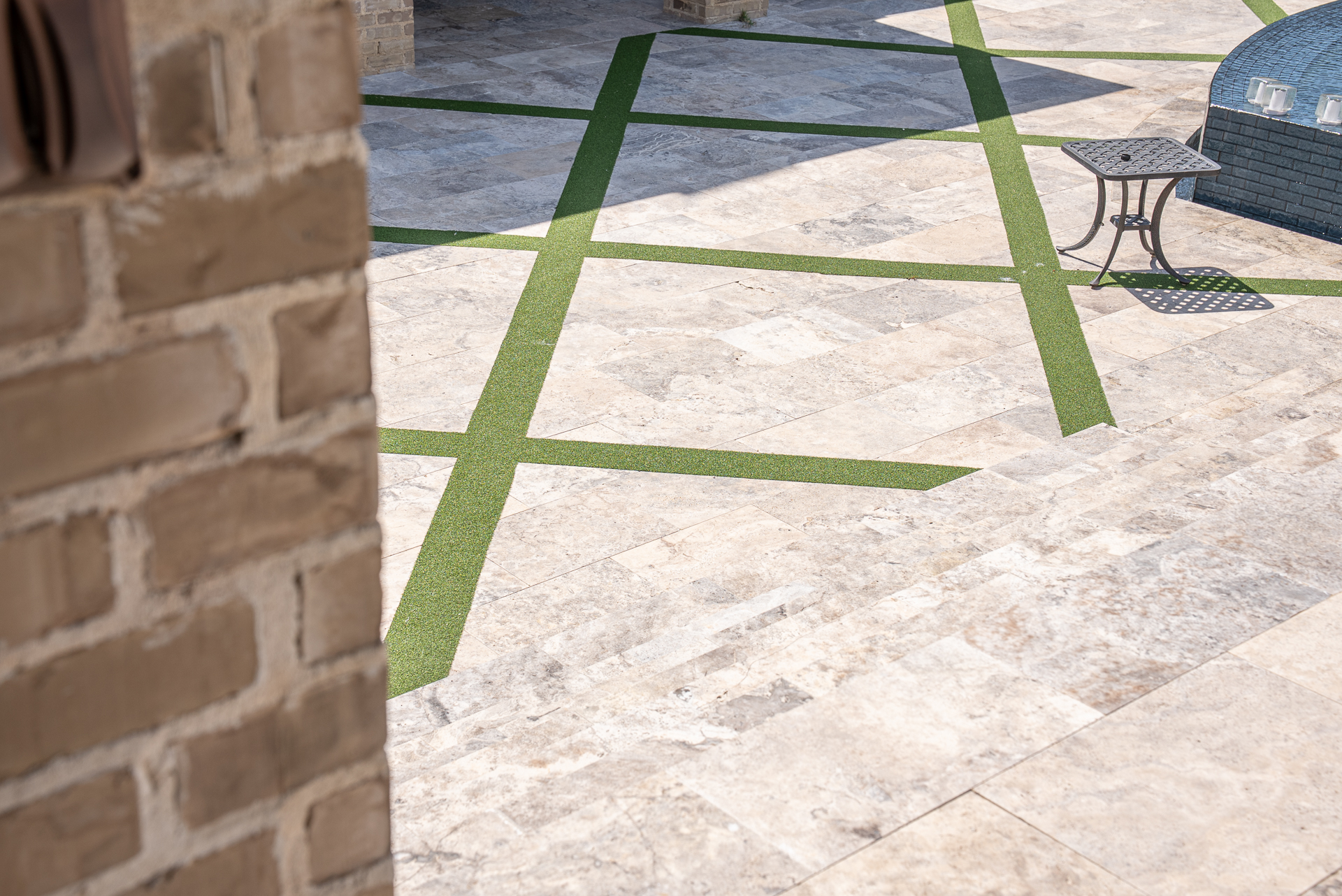
Travertine is a dense natural limestone with a timeless, high-end look, and it has one standout trait that matters enormously in Texas: it stays meaningfully cooler underfoot than concrete in direct sun. On a patio or pool deck where bare feet meet a surface that's baked all afternoon, that difference is the whole experience. It comes in warm, natural tones, ages gracefully, and reads as genuine luxury.
It sits at the premium end of the price range, and as a natural stone it benefits from periodic sealing to resist staining. One important caution for pool owners: around saltwater pools, soft stone can pit and deteriorate from salt exposure. If you're setting travertine near saltwater, confirm it's rated for it — or consider travertine or concrete coping at the water's edge specifically — so you're not redoing it in a few years. We get into coping and pool-deck surfaces more in our pool remodel cost guide. Chosen well for the right setting, travertine is often worth every dollar.
How to Choose
Strip away the brochures and the decision is fairly simple. Choose concrete when budget leads and the site is stable and flat, and insist the joints be planned properly. Choose pavers when you want design flexibility, crack resistance over our clay, and the ability to repair a single unit down the road — especially in root-heavy or sloped yards. Choose travertine when you want a premium look and cooler footing in the sun, particularly around a pool, with an eye toward salt compatibility.
Whatever the surface, the base under it is what determines how long it lasts. In North Texas clay, a properly excavated, compacted, and supported base matters more than almost any other single decision, and it's exactly where a quality build separates itself from a bargain bid. It also helps to choose the surface alongside the rest of the yard rather than in isolation — our guide to planning your outdoor living space covers how the surface, shade, and gathering zones fit together. Get the base right and the planning right, and any of these three materials can serve you for decades.
Frequently Asked Questions
Are pavers or concrete better in North Texas?
For root-heavy or sloped yards, we usually recommend pavers over poured concrete. Concrete tends to crack as our expansive clay soil shifts, and a single crack is hard to fix invisibly. Pavers flex with ground movement and let you replace one unit instead of resurfacing a whole slab.
Why is travertine popular for patios and pool decks in Texas?
Travertine stays noticeably cooler underfoot than concrete in direct sun, which makes a real difference on a hot deck. It also delivers a high-end natural-stone look. Around saltwater pools, though, confirm the travertine is rated for salt exposure, since soft stone can pit over time.
Which patio material lasts longest?
Properly installed pavers and quality natural stone both last for decades, largely because they tolerate ground movement and are repairable. Concrete is durable too, but on our clay soils it's more prone to visible cracking unless the base prep and joint layout are done carefully.
Why does the base matter so much?
In North Texas clay, the compacted base and proper edge restraint determine how long any patio lasts and how well it drains. Skipping base prep or perimeter support is the most common reason a beautiful new patio settles, tips, or erodes within a year.
Work With PROvision
At PROvision Outdoor Living, we design and install paver, travertine, and concrete patios across Southlake, Keller, Grapevine, and North Texas — built on a base engineered for our soil and backed by a lifetime workmanship warranty. Explore our hardscapes and surfaces page to see the materials and projects we work in.
Book a free consultation or call us at (817) 880-7224.


.png)